
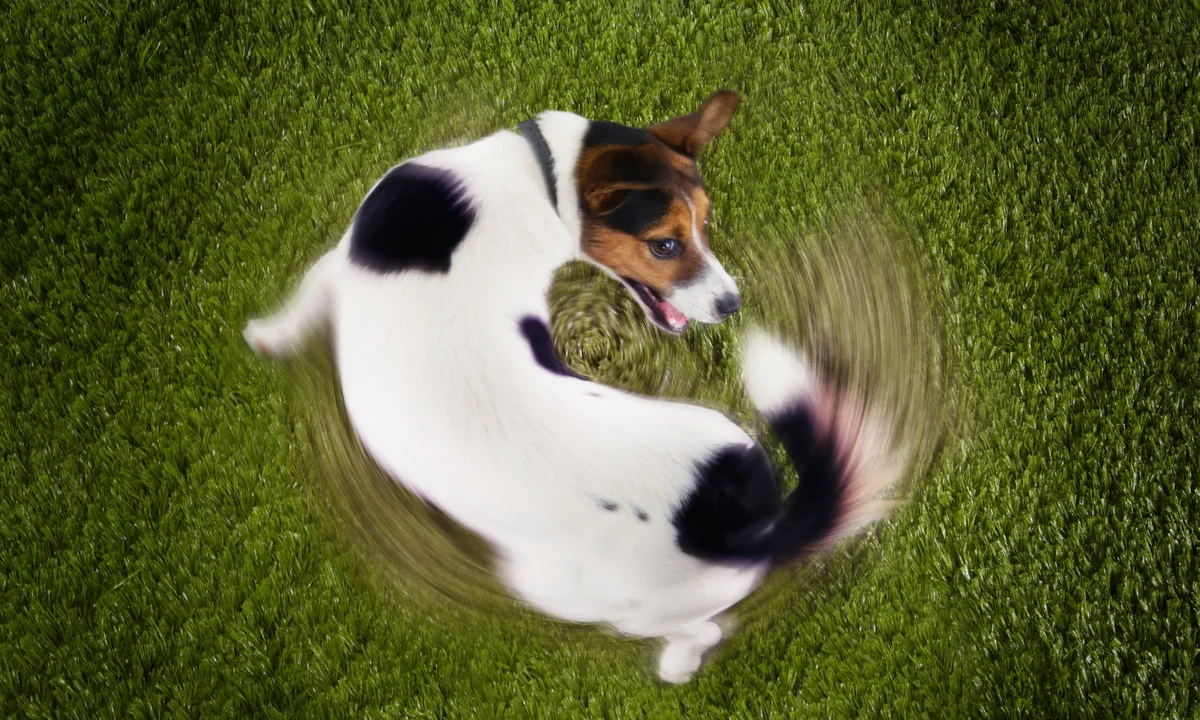
Most people laugh the first time they see it. Some grab their phone. But tail-chasing one of the most misunderstood dog behaviours is more layered than the internet meme it’s become. Understanding why dogs chase their tails matters because the same spinning motion can mean a puppy is playing, a bored adult dog is self-entertaining, or a dog in genuine distress is trying to cope. A study published in PLOS ONE found that roughly one-third of tail-chasing dogs displayed clinical signs — yet owners filming them described the behaviour as “funny” or “cute” 88% of the time. This guide separates what’s harmless from what needs attention, and gives you a clear roadmap for what to do.
- What Is Dog Tail-Chasing?
- Why Tail-Chasing Is More Complicated Than It Looks
- The 5 Reasons Dogs Chase Their Tails
- Medical Causes: Rule These Out First
- Which Dog Breeds Are Most Prone to Compulsive Tail-Chasing?
- Red Flags: When to Contact Your Vet Immediately
- How to Stop Dog Tail-Chasing: Evidence-Based Steps
- Expert Tips for Dog Owners
- Frequently Asked Questions
- Conclusion
- Explore More on FurryInSwag
KEY TAKEAWAYS
- Occasional tail-chasing in puppies is normal; frequent or intense chasing in adult dogs is not
- The five main causes are boredom, attention-seeking, anxiety, canine compulsive disorder (CCD), and medical issues
- Bull Terriers, German Shepherds, and Doberman Pinschers are genetically predisposed to compulsive tail-chasing
- Never laugh at or reward tail-chasing any attention reinforces the behaviour
- Always rule out medical causes before assuming it is behavioural
- Compulsive cases require a veterinary behaviourist, not just owner-led redirection
What Is Dog Tail-Chasing?
Dog tail-chasing, also called tail-pursuit behaviour, is when a dog spins in tight circles in apparent pursuit of its own tail. It ranges from brief, playful episodes especially common in puppies to persistent, compulsive behaviour that interferes with daily life. In clinical cases, it is classified under Canine Compulsive Disorder (CCD), the canine equivalent of human OCD.
Why Tail-Chasing Is More Complicated Than It Looks
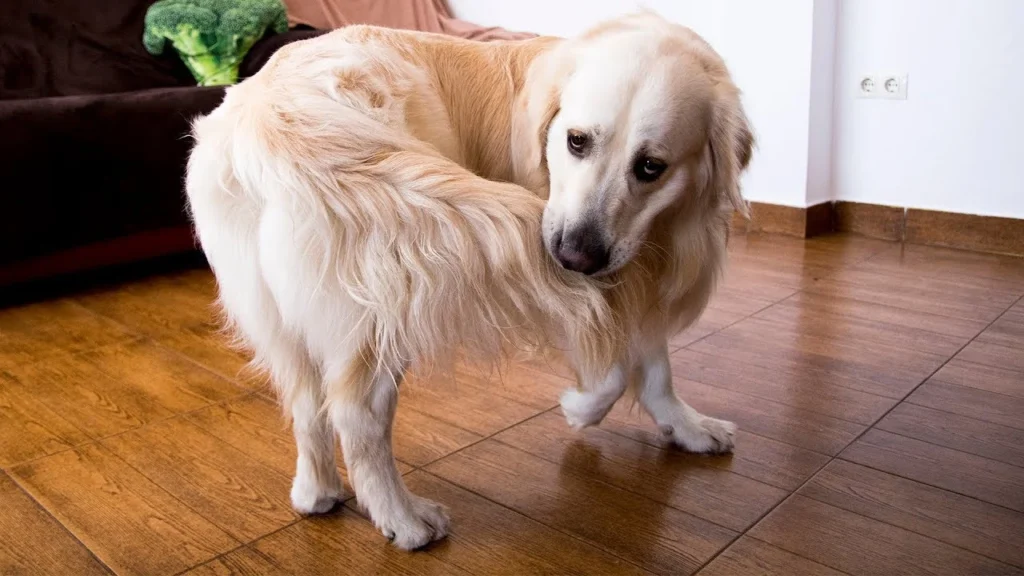
Here is what makes tail-chasing genuinely tricky to interpret: the behaviour looks identical whether the dog is playing, bored, anxious, or experiencing a focal seizure. The motion is the same. The meaning is completely different.
According to the American Kennel Club’s Chief Veterinarian Dr. Jerry Klein, the behaviour is often benign play or attention, to induce someone or something to play with them. But he is equally clear that when the chasing becomes frequent, intense, or hard to interrupt, veterinary involvement is essential. The gap between a puppy discovering its tail and a dog locked in a compulsive loop can be vast and it matters enormously for how you respond.
The 5 Reasons Dogs Chase Their Tails
1. Normal Play and Puppy Exploration
Puppies between three and six months old commonly chase their tails as part of discovering their own anatomy. It is self-directed play the tail moves, the puppy follows. This typically fades on its own as the dog matures. No intervention is needed unless it becomes excessive or persists well into adulthood.
2. Boredom and Under-Stimulation
A dog with unspent physical energy and no mental outlet will manufacture its own entertainment. Tail-chasing is easy, available, and self-reinforcing. If your dog spins primarily after long inactive periods, boredom is the most likely driver. Two 30-minute walks daily, puzzle feeders, scent games, and structured play sessions address the root cause directly.
3. Attention-Seeking Behaviour
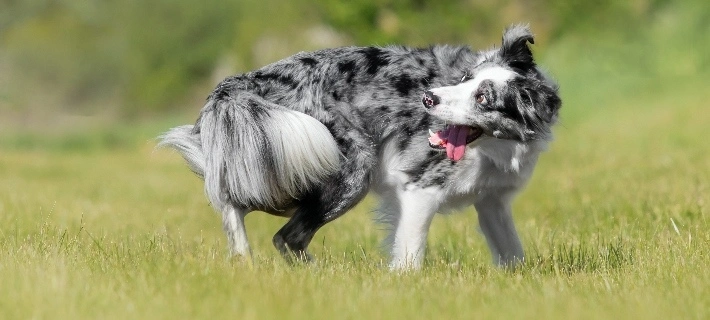
Dogs read human reactions precisely. If tail-chasing once produced laughter, clapping, or even a concerned reaction it worked. The dog learned that spinning equals getting noticed. This is operant conditioning at its most efficient, and it happens fast. Ignore the spinning; reward the stillness.
4. Anxiety and Stress
Repetitive behaviours are a classic anxiety response in dogs the canine equivalent of nail-biting or foot-tapping. A dog that chases its tail before vet visits, during thunderstorms, when left alone, or after household changes is likely self-soothing. Watch for accompanying signs: panting, pacing, whining, destructive behaviour, or house-training regression.
5. Canine Compulsive Disorder (CCD)
CCD is the most serious behavioural cause and the one most frequently missed. It is characterised by repetitive behaviour a dog feels compelled to perform and cannot easily stop. The 2012 PLOS ONE study found that compulsive tail-chasers had significantly higher rates of fearfulness and anxiety and were notably harder to distract mid-episode. If the chasing escalates in frequency, cannot be interrupted, or leads to self-injury, this is clinical territory requiring a veterinary behaviourist.
Medical Causes: Rule These Out First
Before concluding any tail-chasing is purely behavioural, a full vet examination is non-negotiable. Common physical triggers include:
- Anal gland impaction or infection – discomfort at the tail base drives focus toward that area
- Fleas or mites – infestation causes intense itching, particularly near the tail’s base
- Skin allergies or hot spots– localised irritation can provoke repeated circling and biting
- Tail injuries – fractures, sprains, or nerve damage make dogs hyper-aware of the tail
- Focal (partial) seizures– repetitive spinning with disorientation post-episode can indicate seizure activity
If tail-chasing starts suddenly in a dog with no previous history, a medical cause is the first thing to investigate – not the last.
Which Dog Breeds Are Most Prone to Compulsive Tail-Chasing?
Not all dogs carry equal risk. Research consistently identifies Bull Terriers as having the highest rates, followed by German Shepherds, Staffordshire Bull Terriers, Doberman Pinschers, Cattle Dogs, and Shiba Inus. Studies suggest a potential genetic component linked to the CDH2 gene, though the causal relationship is still debated in veterinary literature.
Breed predisposition does not make compulsive behaviour inevitable but it does mean owners of these breeds should take persistent tail-chasing more seriously and seek veterinary input earlier.
Red Flags: When to Contact Your Vet Immediately
Not every tail-chasing episode warrants a clinic visit. But these signs do:
- Chasing occurs daily or multiple times per day
- The dog cannot be interrupted or redirected mid-episode
- The tail has been bitten, shows broken hair, sores, or open wounds
- Other repetitive behaviours are present (shadow-chasing, fly-snapping, excessive licking)
- The dog appears disoriented, dazed, or distressed after an episode
- The behaviour started suddenly with no identifiable trigger
How to Stop Dog Tail-Chasing: Evidence-Based Steps
- Step 1: Rule out medical causes. Book a vet examination first. Request checks on anal glands, skin condition, and a basic neurological assessment. If a physical cause is found, treating it often resolves the behaviour.
- Step 2: Increase enrichment. For boredom-driven chasing, two structured daily walks plus 15 to 20 minutes of mental enrichment (puzzle feeders, nose work, training games) is often sufficient within weeks.
- Step 3: Remove the attention reward. Withdraw all response turn your back, leave the room. Reward calm, settled behaviour generously. A single laugh mid-session resets the conditioning.
- Step 4: Address anxiety directly. Consult your vet about anxiety management. Depending on severity, this might include behaviour modification, calming supplements, or prescription SSRIs such as fluoxetine.
- Step 5: Work with a certified professional. For CCD or anxiety-driven cases, a certified veterinary behaviourist (Dip ACVB) or clinical animal behaviourist (CCAB) is the appropriate level of support.
Expert Tips for Dog Owners
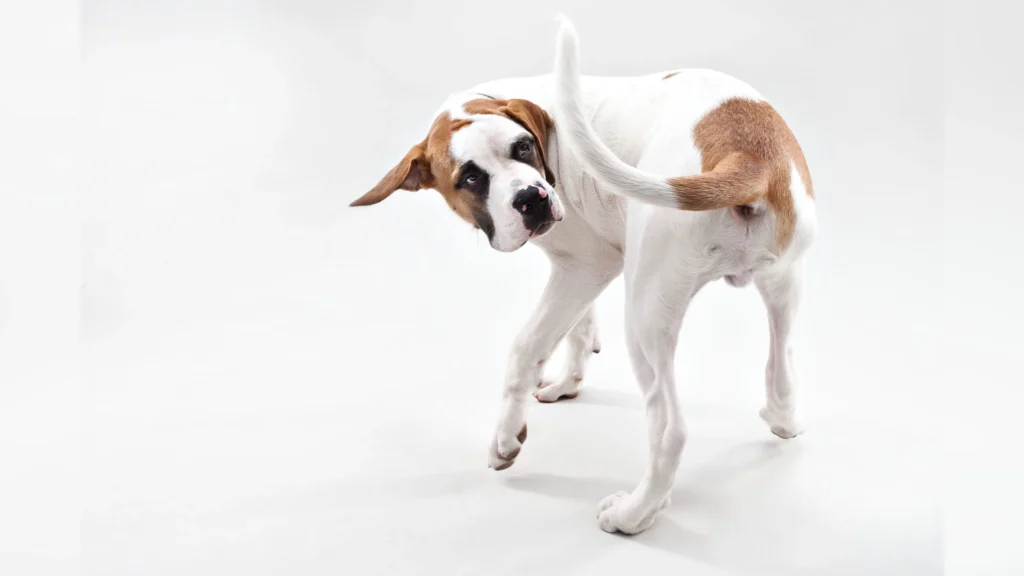
- Do not film it. Any attention even laughter reinforces the behaviour. And if the dog is showing clinical signs, amusement delays appropriate intervention.
- Track the pattern. Log when episodes occur, how long they last, and what preceded them. This data is invaluable for a vet or behaviourist identifying triggers.
- Never use punishment. Scolding or physically stopping a tail-chasing dog does not address the cause and for anxious or compulsive dogs, it actively makes the underlying condition worse.
- Act early. The longer compulsive tail-chasing persists, the more ingrained the behaviour becomes. Early intervention consistently produces better outcomes.
Frequently Asked Questions
Conclusion
Tail-chasing sits at an unusual intersection: genuinely harmless in some dogs, a clinical problem in others, and almost always misread by the humans watching it. Understanding why dogs chase their tails means looking past the comedy of the spin and asking what that particular dog, in that particular context, is actually communicating.
Track the frequency. Know the warning signs. Rule out medical causes first. And if the behaviour persists or escalates get professional support early, before it becomes a conditioned habit that takes months to unpick. Your dog is telling you something; it is worth finding out what.
Explore More on FurryInSwag
- how to stop dog pulling on leash — practical techniques to stop pulling for good.
- how brain training games can fix aggressive dog behavior — how brain games specifically address reactive and aggressive behaviour.
- best puzzle toys for smart dogs — our top picks for dogs at every intelligence level.
- how to train a stubborn dog without punishment — force-free methods that work even on the most resistant dogs.
- Is Brain Training for Dogs worth it? — our full breakdown of the program, cost, and what to expect.
Last Updated on March 28, 2026 by Sunil Kandari

Sunil Kandari
Sunil Kandari is a WordPress Developer and Content Writer with expertise in building high-performance websites and creating SEO-friendly content. He focuses on clean design, user experience, and practical strategies that help businesses grow online. Passionate about technology, he continuously explores new tools and trends to deliver better digital solutions.