
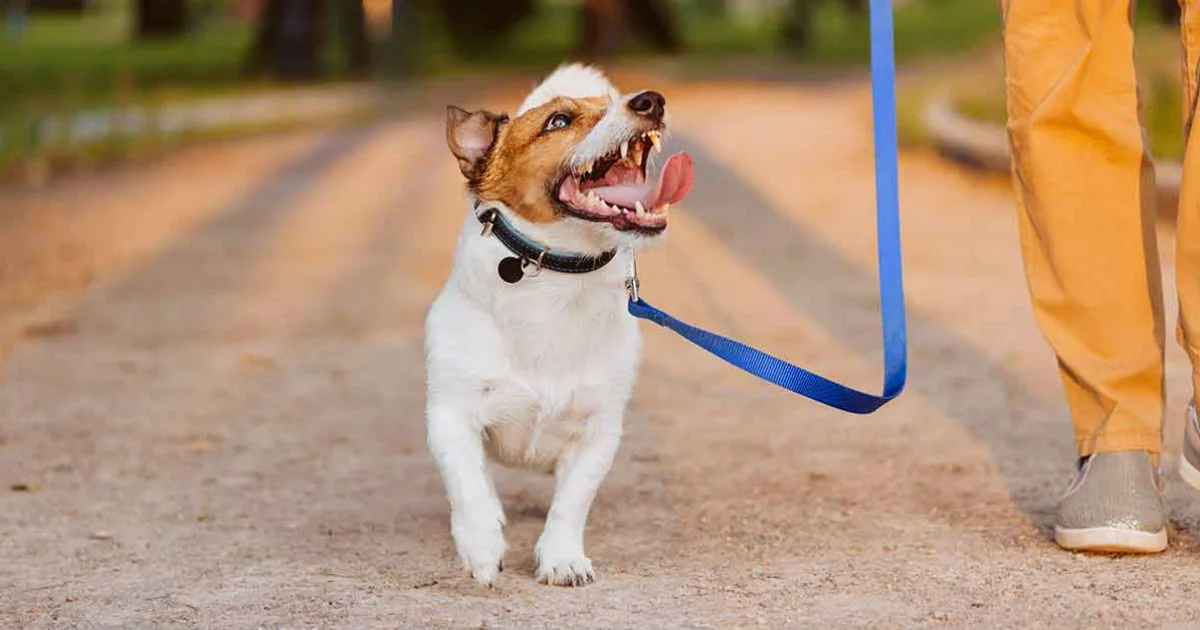
You clip the leash on. Your dog immediately transforms into a sled dog. Sound familiar? Leash pulling is one of the most common problems dog owners deal with — and one of the most misunderstood. Most people try harder equipment: choke chains, prong collars, no-pull harnesses. The dog pulls anyway.
- Key Takeaways
- Why Your Dog Pulls — And Why It Isn't Stubbornness
- What Is the Brain-Based Approach?
- Pre-Walk Brain Training: What to Do Before You Leave the House
- How to Stop a Dog From Pulling on the Leash: The Walking Method
- Want a Full System? Brain Training for Dogs
- Common Mistakes That Keep Your Dog Pulling
- Expert Tips for Faster Results
- Frequently Asked Questions
- Final Thoughts: Fix the Brain, Fix the Walk
The reason these fixes don’t stick is simple: they address the symptom, not the cause. Your dog pulls because they haven’t developed the impulse control to choose differently — and impulse control is a brain skill, not a leash skill. Fix the brain first, and the walk fixes itself.
This guide gives you a practical, force-free method to stop a dog from pulling on the leash — combining the right walking technique with pre-walk brain training that genuinely changes how your dog thinks during the outing.
Key Takeaways
- Pulling is a self-reinforced habit — every successful pull taught your dog that tension moves the walk forward.
- Impulse control is the core skill missing in dogs that pull. It must be trained, not assumed.
- 10–15 minutes of brain training before a walk lowers arousal and dramatically improves focus.
- The red light/green light method works — but only with absolute consistency across every walk and every person.
- Force-free tools and structured training programs produce lasting behavioral change; punishment-based collars do not.
Why Your Dog Pulls — And Why It Isn’t Stubbornness
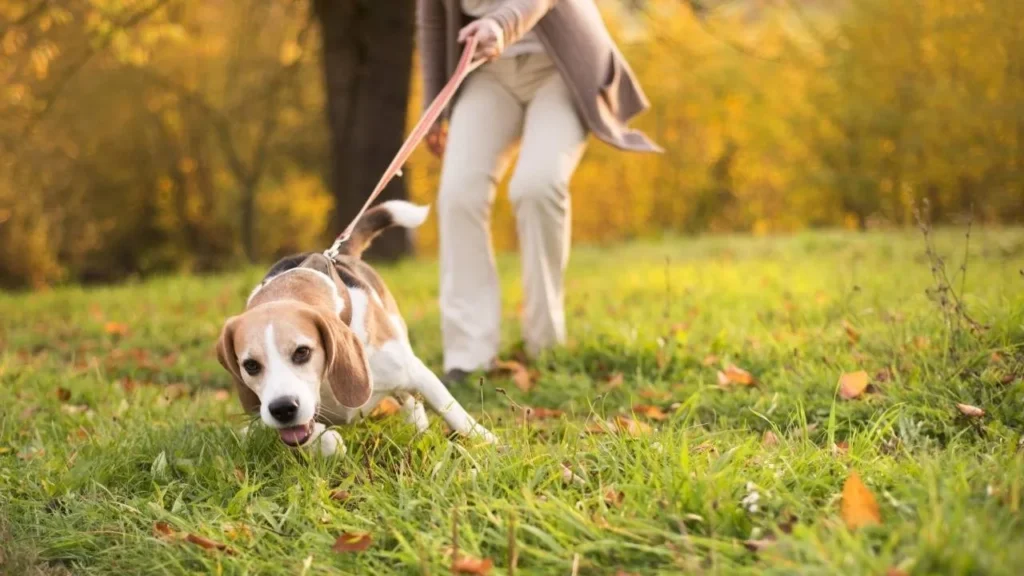
Dogs pull for one reason: it has always worked. Every time your dog strained forward and you kept walking, they learned that tension equals forward progress. That’s not a character flaw — it’s a conditioned behavior with a long reward history.
There’s also a physical element. Dogs have what trainers call an opposition reflex — when pressure is applied in one direction, they instinctively lean into it. A tight leash doesn’t slow most dogs down. It activates them.
Add to this the fact that most dogs arrive at walks already mentally over-stimulated from sitting idle all day. A dog with unspent mental energy has low impulse control from the start. This is why regular exercise alone isn’t enough — the brain needs engagement too, not just the body.
What Is the Brain-Based Approach?
Brain-based leash training works on what’s happening inside your dog’s head before and during the walk. The core principle is impulse control: the ability to pause before reacting. This skill lives in the prefrontal cortex and — just like a muscle — it strengthens with practice.
Dogs who regularly do brain training games develop better self-regulation across all their behavior — not just on leash. Their baseline arousal level drops. Their default attention to their owner increases. And when you combine that with the right walking technique, you get a fundamentally different dog to take outside.
💡 Key insight A mentally tired dog is a calmer dog. Ten minutes of focused mental work before a walk consistently produces a more focused, less reactive dog at the start of the outing.
Pre-Walk Brain Training: What to Do Before You Leave the House
1. Puzzle feeding instead of a bowl
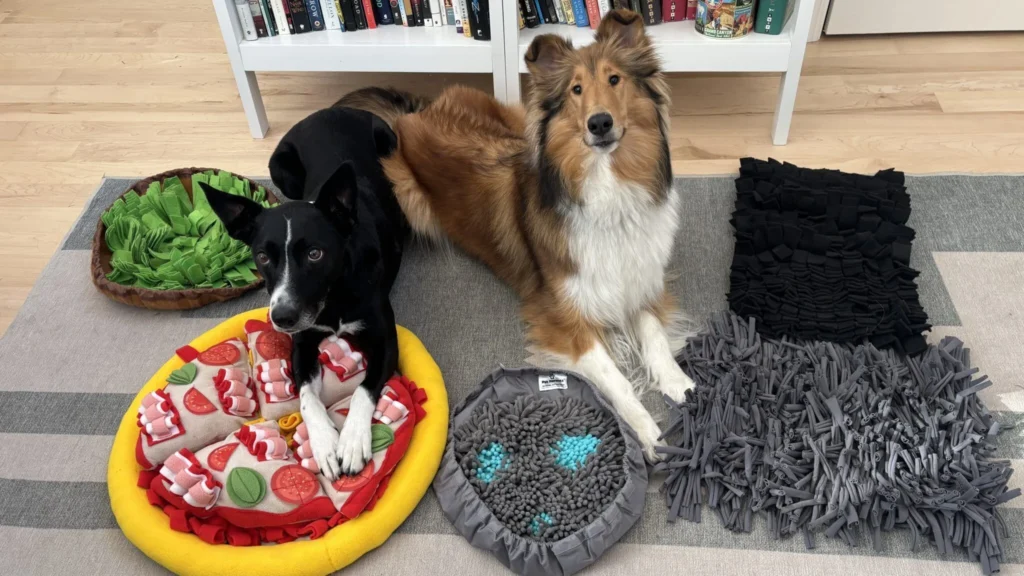
Rather than feeding breakfast in a bowl, use a puzzle feeder or snuffle mat. This engages the olfactory and problem-solving systems simultaneously and is one of the simplest pre-walk calming activities available. Check out the best puzzle toys for smart dogs if you’re looking for where to start — even Level 1 puzzle feeders make a noticeable difference.
2. Threshold waiting at the front door
Before opening the door, ask your dog to sit or stand still. Only open the door when they are calm. If they rush forward, close it and reset. This single daily exercise builds the habit of pausing at decision points — and the front door is the first decision point of every walk.
3. The It’s Your Choice game (5 minutes)
Hold a treat in your open fist. When your dog lunges for it, wait. The moment they pause and back off, open your hand and reward. Repeat 10–15 times. This game directly trains the impulse-control neural pathway — the same pathway that stops a dog from lunging mid-walk.
4. Name game for attention
Say your dog’s name once, calmly. The instant they look at you, mark with “yes” and reward. Repeat 20 times. Do this indoors first, then near the front door, then outdoors. A dog with a reliable attention response gives you a split second to redirect before they hit the end of the leash — and that split second is everything.
How to Stop a Dog From Pulling on the Leash: The Walking Method
- Choose the right equipment — A standard 6-foot flat leash is ideal. Avoid retractable leads during training — they actively reward pulling by extending the dog’s range. For strong pullers, a front-clip harness (like the PetSafe Easy Walk) redirects momentum without pain and makes early sessions far more manageable.
- Start in a zero-distraction environment — Begin in your living room or garden. The more distractions present, the harder it is for a dog with no history of loose leash walking to succeed. Build the skill where it’s easy, then add difficulty.
- Apply the red light / green light rule — without exception — The rule is absolute: the walk moves forward only when the leash is loose. The moment tension appears, you stop. Plant your feet and wait. When your dog releases the tension — even slightly — mark with “yes” and move forward as the reward. Early sessions feel slow. That’s normal. You’re dismantling years of reward history.
- Use direction changes to break fixation — When your dog is pulling consistently forward, turn 180 degrees calmly and walk the other way. This puts the dog behind you and interrupts the fixation on whatever they were pulling toward. When they catch up alongside you, reward generously.
- Reward position, not just absence of pulling — Every time your dog is walking loosely next to you — even briefly — mark it and reward with a high-value treat. You’re building a positive association with the heel position itself. Dry kibble isn’t motivating enough for this. Bring chicken, cheese, or soft liver treats.
- Build up distraction gradually — Once your dog walks consistently on a loose leash in a quiet area, add distractions slowly: a parked bicycle, another person at distance, then a dog at distance. Lower your expectations temporarily each time you add a new distraction. Success builds the habit; failure rehearses the old one.
Want a Full System? Brain Training for Dogs

If you want a structured curriculum rather than piecing techniques together, Brain Training for Dogs by Adrienne Farricelli is worth a serious look. It’s a CPDT-KA certified, force-free program structured like a school — from Preschool through Graduation — building impulse control, focus, and real-world manners including loose leash walking.
Many owners report that leash behavior improves as a side effect of the broader brain training work — because the program addresses the root cause directly. If you’re wondering whether it’s worth the investment, read our full Brain Training for Dogs review here.
Common Mistakes That Keep Your Dog Pulling
- Inconsistency: If pulling works on even one walk, the dog keeps trying it. Every person who walks the dog must follow the same rules, every single time.
- Using retractable leashes during training: These teach dogs that tension equals more range — the exact opposite of what you need.
- Repeating commands: Saying “heel, heel, HEEL” while your dog ignores you teaches them the first cue is optional. Say it once, then use movement and body position to communicate.
- Skipping the pre-walk mental work: Walking a mentally under-stimulated dog is fighting an uphill battle. Arousal is high before you start. Ten minutes of brain work beforehand changes the entire dynamic.
- Rushing to high-distraction environments: Training on a busy street before establishing the behavior at home is setting your dog up to fail. Earn the behavior where it’s easy first.
Expert Tips for Faster Results
- Use sniff breaks as life rewards: Allow your dog to sniff freely for 30 seconds after 20 good steps. Sniffing activates the parasympathetic nervous system — it’s genuinely calming. Use it as currency.
- Two short sessions beat one long one: A 10-minute focused session produces better results than a 40-minute walk where pulling is constantly reinforced. Train in short bursts and end before your dog loses focus.
- Get the whole household aligned: One family member who lets the dog pull undermines every training session by everyone else. One conversation about the rules is worth weeks of solo effort.
For dogs that pull specifically because they’re mentally under-stimulated, improving their overall brain health makes a lasting difference. Our guide on how brain training improves your dog’s mental health goes deeper on this connection.
Frequently Asked Questions
Final Thoughts: Fix the Brain, Fix the Walk
Leash pulling isn’t proof your dog is dominant or disrespectful. It’s the predictable result of a dog who learned that tension moves things forward and hasn’t yet built the impulse control to choose differently.
The brain-based approach works because it addresses this at the source. Combine consistent loose leash walking technique with pre-walk mental engagement — puzzle feeders, brain training games, impulse control exercises — and you’re giving your dog the actual skills they need, not just managing a symptom.
For a complete, structured version of everything covered here, Brain Training for Dogs provides a step-by-step force-free curriculum you can follow entirely at home. Start today — your future walks will thank you.
Last Updated on March 19, 2026 by Sunil Kandari

Sunil Kandari
Sunil Kandari is a WordPress Developer and Content Writer with expertise in building high-performance websites and creating SEO-friendly content. He focuses on clean design, user experience, and practical strategies that help businesses grow online. Passionate about technology, he continuously explores new tools and trends to deliver better digital solutions.