
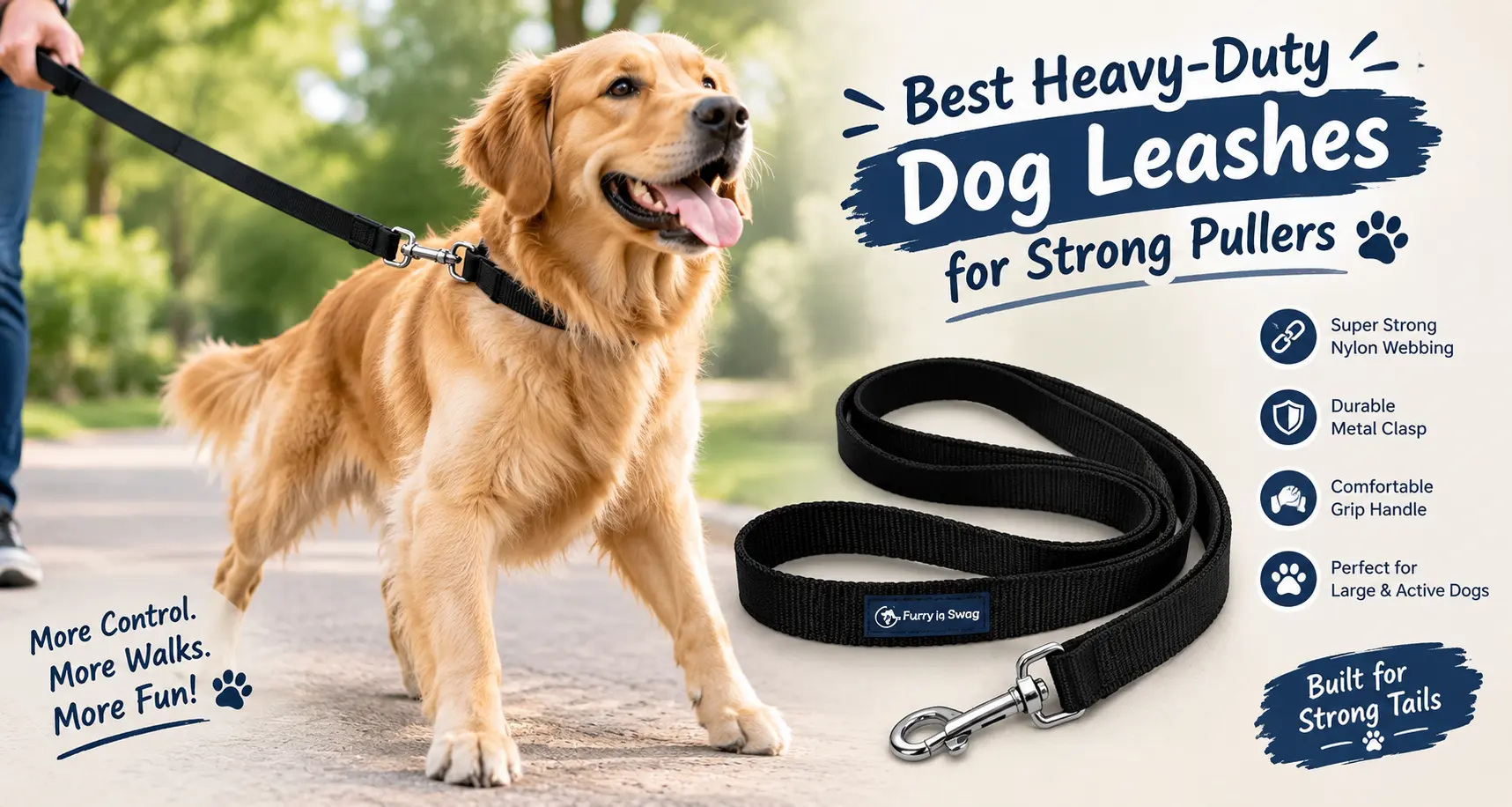
Walking a strong dog on a thin leash is tiring at best and risky at worst. A sudden lunge at a cat or a cyclist puts a lot of force through the leash, your wrist and your shoulder, and a worn clip or weak stitching is the first thing that gives way.
This guide to the best heavy-duty dog leashes covers seven styles built for strong pullers, from reinforced webbing to double handles and shock-absorbing bungee. For each one you will see what it does best, who it suits and what to check before you buy. You can start with the leashes at Furry in Swag and use this guide to pick the right style.
Key Takeaways
- Choose strength you can see. Thick webbing, firm stitching, a solid ring and a strong clip matter more than the label.
- Comfort protects you. A padded or well-shaped handle spreads the load across your hand.
- Use a fixed length. About 1.2 to 1.5 metres gives control, and a retractable leash does not.
- A leash is a tool, not a cure. It makes pulling safe to handle while training teaches loose-leash walking.
- Inspect it often. Check stitching, handle and clip before every walk.
What Is a Heavy-Duty Dog Leash?
A heavy-duty dog leash is a fixed-length leash made from thick, strong material, with reinforced stitching and robust hardware, designed to handle the force of a large or strong dog. It usually has a wider or thicker body, a solid metal ring and clip, and a handle shaped to stay comfortable under strain.
What Should You Look for in a Strong Dog Leash?
Four details decide whether a leash will hold up for a strong puller:
- Material. Thick woven webbing or climbing-style rope resists fraying and stretching better than thin cord.
- Stitching and handle. Look for tight, even stitching where the handle folds back, because that is where leashes fail first.
- Hardware. A solid metal clip that closes firmly, and a ring that is not thin or hollow. A swivel clip stops the leash twisting.
- Length and width. A fixed length of about 1.2 to 1.5 metres suits most strong dogs, and a wider body feels more secure in the hand.
Why Are Retractable Leashes a Poor Choice for Strong Dogs?
Retractable leashes lock suddenly when the dog reaches the end, and a strong dog can yank the handle from your hand. They also give you less control near roads, cyclists and other dogs, because you cannot shorten them quickly. For a strong puller, a fixed-length leash is the safer pick.
Which Heavy-Duty Dog Leashes Are Worth Buying?
These seven styles cover most strong dogs. You can use one for everyday walks and keep another for busy streets or training.
1. The Heavy-Duty Webbing Leash
Flat woven webbing spreads the load across a wide surface, stretches very little and keeps its shape through rain, mud and washing. It is also light enough to carry on a long walk, which matters when your dog leans into every step.
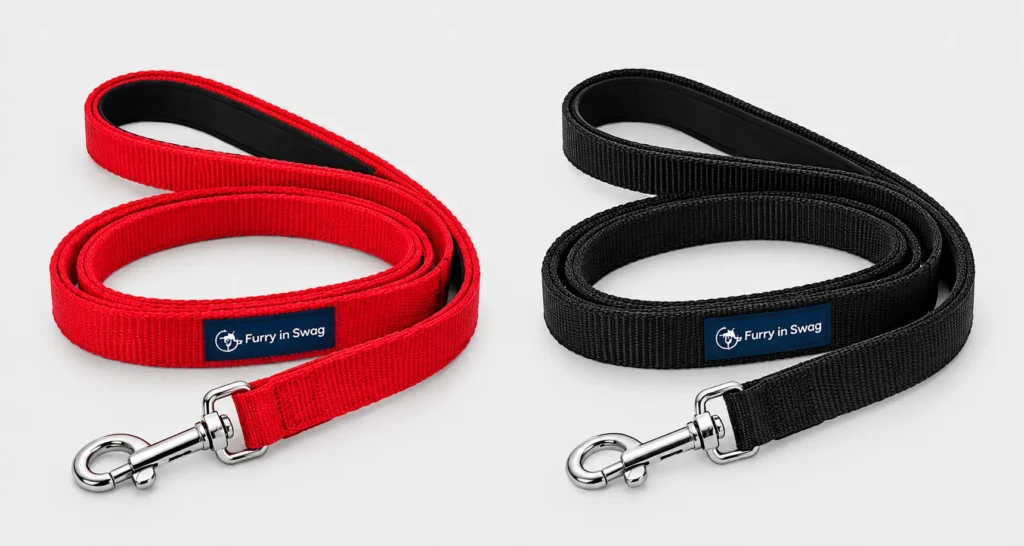
Check how it is finished: tight, even stitching at the handle fold, a solid metal ring and a clip that closes with a firm click. The FIS Heavy Duty Leash is the one to start with for large and strong dogs, and it pairs well with a collar in black or red.
Watch out for: thin or loosely stitched handles and flimsy clips. Keep a firm, two-handed grip when your dog lunges.
Best for: large dogs and everyday walks.
2. The Double-Handle Traffic Leash
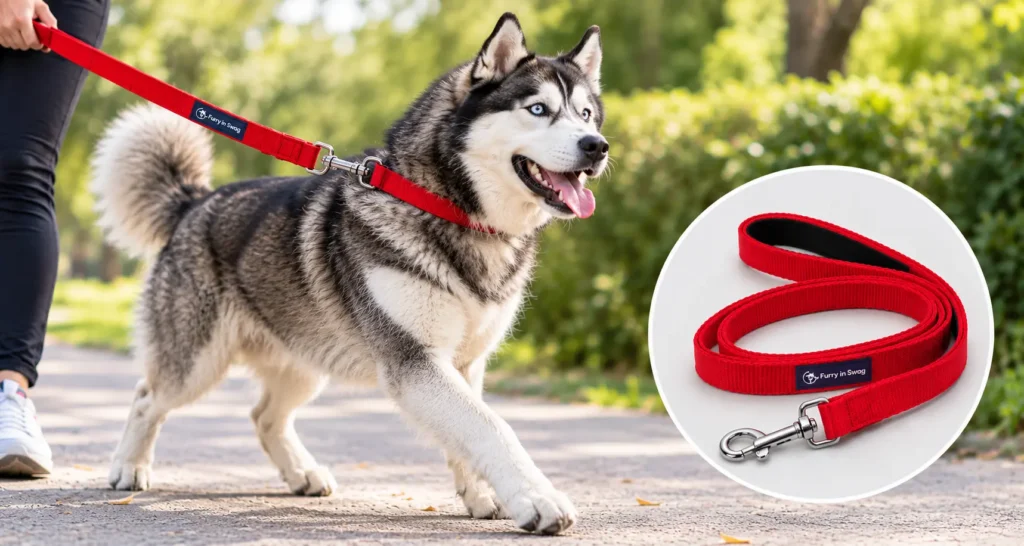
A second handle sits a short distance along the leash, close to the clip. Slide your hand to it and your dog is instantly on a shorter lead, so the leash works like two in one.
It is most useful at road crossings, on crowded pavements and when you pass another dog. Practise the switch in a quiet place first, and use the short grip for busy moments only, since holding a dog short all the time can make it tense.
Watch out for: a second handle that is thin or poorly stitched, because it takes the full pull.
Best for: busy streets and dogs that lunge without warning.
3. The Padded-Handle Leash
With a strong dog, almost every pull goes through your hand. A padded handle spreads that force over a larger area, so the leash feels more secure and far less harsh on long walks.
Look for padding that is stitched in rather than glued, and a handle shaped to sit comfortably in the hand, even with gloves. Padding does not make the leash stronger, so check the webbing, ring and clip as well.
Watch out for: padding that slips or holds water. Dry the handle after wet walks.
Best for: long walks and owners with sensitive or weaker hands.
4. The Shock-Absorbing Bungee Leash
A bungee leash has a stretch section that works like a shock absorber. When your dog lunges, the stretch takes the first jolt instead of passing it to your wrist and shoulder, and it is gentler on your dog’s neck or harness.
Choose one with a strong, non-stretching core so the leash still holds if the elastic wears out, and use it with a well-fitted harness. Keep the length around 1.2 to 1.5 metres so your dog cannot build up speed.
Watch out for: slightly less direct control than fixed webbing, and cheap elastic that wears out.
Best for: dogs that jerk and owners with sore shoulders.
5. The Climbing-Style Rope Leash
Rope leashes use thick, tightly braided rope similar to climbing rope. The round shape is comfortable to grip, the braid resists fraying, and the leash stays flexible in cold weather and works well when wet.
Look for a stitched or wrapped handle and a solid metal clip, ideally a bolt-snap style. Rope is heavier than webbing, so check the weight if your dog is medium-sized.
Watch out for: extra weight and bare rope handles, which can burn the hand if the leash slides.
Best for: strong dogs and wet-weather walks.
6. The Short Training Leash
A leash of about one metre keeps your dog beside you and leaves little slack to build up speed, so pulling is easier to correct. It suits crowded places, vet visits and loose-leash training.
Pair it with treats: reward your dog when the leash hangs loose, and stop and wait when it tightens. Our guide on how to stop your dog from pulling on the leash covers the full method. Keep a longer leash for relaxed walks, since dogs also need time to sniff.
Watch out for: relying on it alone. It is a training tool, and it does not teach anything without rewards.
Best for: training sessions and crowded places.
7. The Chew-Resistant Reinforced Leash
Some strong dogs chew the leash as well as pull on it, especially teething adolescents. A reinforced leash has a tougher section near the clip, such as coated cable or a chain link, so the part your dog reaches most is harder to bite through.
Choose a design that stays light and has smooth edges where the metal meets the handle and clip. It protects the leash, not the habit, so give your dog something to carry and reward calm walking.
Watch out for: metal sections that are heavy, noisy or rough on the teeth.
Best for: dogs that chew the leash and teething adolescents.
Quick Guide: Which Leash for Which Dog?
| Leash type | Best for | Keep in mind |
| Heavy-duty webbing | Large dogs, everyday walks | Check stitching and clip |
| Double-handle | Busy streets, sudden lunges | Practise switching handles |
| Padded-handle | Long walks, sore hands | Padding should be stitched in |
| Bungee | Dogs that jerk | Choose a reinforced core |
| Rope | Strong dogs, wet weather | Check weight and handle |
| Short training | Training and crowds | Not a substitute for training |
| Chew-resistant | Chewers | Redirect the chewing |
How Do You Choose the Right Heavy-Duty Leash?
- Think about your dog’s strength and size. A bigger, stronger dog needs a wider leash and stronger hardware.
- Choose the length. Pick a fixed length of about 1.2 to 1.5 metres for control.
- Check the build. Look at the stitching, the ring and the clip, and make sure the clip closes firmly.
- Test the handle. It should feel comfortable in your hand, even under pressure.
- Pair it with a good collar or harness. A well-fitted collar or harness spreads the force, so read our guide to the best dog collars that are durable and comfortable.
Frequently Asked Questions
What length leash is best for a strong puller?
A fixed leash of about 1.2 to 1.5 metres gives you good control without letting your dog build up speed. Longer leashes suit open spaces and training, but in busy places they give a strong dog too much room to lunge.
Are retractable leashes safe for strong pullers?
They are not a good match. A retractable leash gives you little control, it locks suddenly when the dog hits the end, and a hard pull can drag the handle out of your hand. A fixed-length, heavy-duty leash is safer for strong dogs.
How often should I check my dog’s leash?
Glance at the stitching, the handle and the clip before every walk, and do a closer check every few weeks. Replace the leash at the first sign of fraying, a cracked clip or loosening stitches.
Should I use a collar or a harness with a strong puller?
A well-fitted harness spreads the force across the chest and is often more comfortable for dogs that pull hard. Many owners keep a collar on for the ID tag and clip the leash to the harness. A correctly fitted collar is fine for dogs that walk calmly.
Final Thoughts
The best heavy-duty dog leashes are strong where it counts: thick webbing or rope, firm stitching, a solid clip and a handle that is comfortable in your hand. Start with one reliable leash for everyday walks, and add a double-handle or bungee style if your dog’s habits call for it.
Ready to choose? Browse leashes, collars, bandanas and bows at Furry in Swag, or see our guide to dog gift ideas for dog lovers if you are buying for a friend. Join the newsletter on our homepage for offers.