
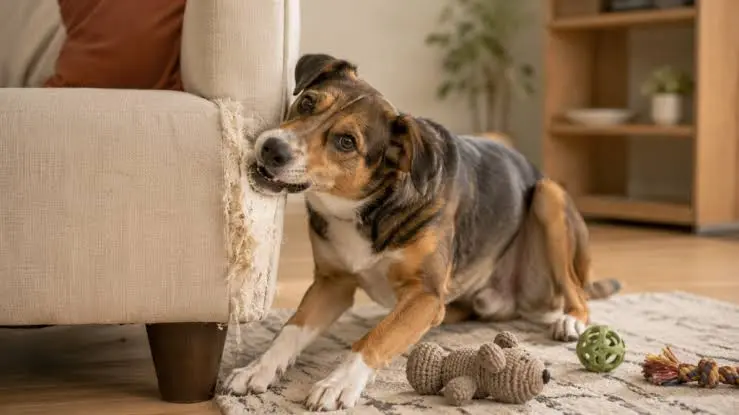
You come home, open the door, and there it is: one chappal on the floor, the other one in pieces, and a fresh bite mark on the sofa leg. Your dog looks at you as if nothing happened.
If this sounds familiar, you are not alone, and your dog is not being naughty on purpose. Chewing is a natural dog behaviour. The real problem starts when your dog picks the wrong things to chew. The good news is that you can teach a dog what is okay to chew and what is not, and you do not need harsh methods to do it.
Table of Contents
In this guide, you will learn why dogs chew furniture and shoes, nine practical ways to stop it, a simple 7-day plan to get started, and what to do if your dog swallows something it should not have.
Why Does My Dog Chew Furniture and Shoes?
Before you fix the habit, it helps to know the reason behind it. Dogs explore the world with their mouths, and chewing also helps them relax. Here are the most common causes:
- Teething. Puppies chew to ease sore gums while their adult teeth come in. This usually settles around 4 to 6 months of age.
- Boredom. A dog with nothing to do will make its own entertainment, and a cushion is very entertaining.
- Extra energy. Dogs that do not get enough exercise often release that energy through chewing, especially in apartments.
- Stress or separation anxiety. Shoes and clothes smell like you, so an anxious dog may chew them while you are away.
- Attention seeking. If chewing gets a big reaction from you, some dogs repeat it.
- Dental or medical discomfort. A dog that suddenly starts chewing more than usual may have a sore tooth or an upset stomach.
At What Age Do Dogs Stop Chewing?
Most puppies chew heavily until their adult teeth are in, which is around 4 to 6 months. Many dogs then go through a second chewing phase as teenagers, when they test limits and have a lot of energy. Some dogs, especially strong chewers, keep the habit for life.
The point is simple. A dog will not always grow out of chewing by itself, so guidance matters. Your goal is not to stop chewing completely. Your goal is to point it at the right things.
How Do You Stop a Dog From Chewing Furniture and Shoes?
Use these nine steps together. One method alone rarely works, but a combination usually does.
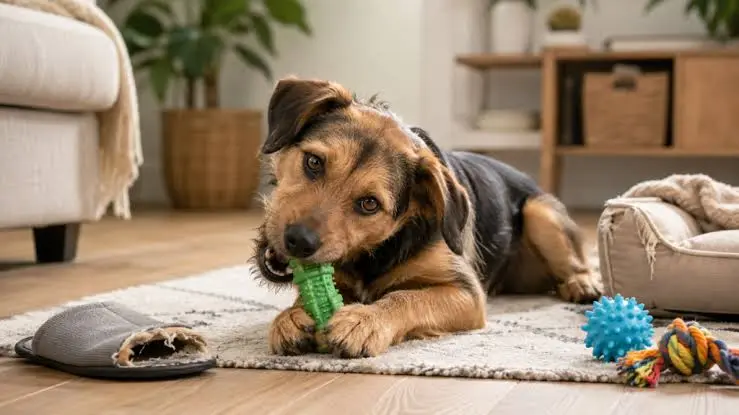
1. Remove the temptation first
The fastest fix is also the easiest. If your dog cannot reach your shoes, it cannot chew them. Keep chappals, sandals and sports shoes on a closed shoe rack or inside a cupboard, and keep clothes, socks and cushions off the floor. If one room is a problem, use a baby gate to block it or close the door when you cannot watch your dog.
Every time your dog successfully chews something it should not, the habit gets stronger. Preventing the chance is the first step to breaking the cycle.
2. Give chew toys that look nothing like your belongings
Offer toys that are clearly different from household items. Rubber chew toys, rope toys and treat-stuffed toys all work well. Rotate them every few days so they feel new.
Do not give your dog an old shoe or sock to play with. Your dog cannot tell the difference between the old one and your new pair.
3. Redirect calmly when you catch your dog chewing
If you see your dog chewing the wrong thing, calmly say “leave it,” take the item away, and hand over a chew toy. When your dog starts chewing the toy, praise it or give a small treat. This teaches your dog that the toy brings rewards and the sofa does not.
Do not shout or chase your dog. Fear does not teach a dog what to chew. It only teaches the dog to chew when you are not looking.
4. Give your dog enough exercise and brain work
A tired dog is a calm dog. Most dogs need at least one or two good walks every day, plus some play. If you live in an apartment, add short games like fetch or tug in the hallway.
Slow, sniff-heavy walks tire a dog mentally as well as physically. Use a comfortable, secure leash so you can let your dog explore without worrying about control. If your dog pulls hard on walks, our guide to 7 Best Heavy-Duty Dog Leashes for Strong Pullers can help you pick the right one.
Food puzzles and treat-dispensing toys add mental exercise on days when walks are short.
5. Use a taste deterrent safely
A bitter-tasting anti-chew spray can help with furniture legs, cords and other things you cannot move. Always test a small hidden patch first to make sure it does not stain, and watch your dog the first time you use it. Not every dog is bothered by the taste, so treat it as a helper, not the whole solution.
Keep the spray away from your dog’s eyes and nose, and choose a product made for pets.
6. Create a special spot where chewing is allowed
Dogs feel safer and calmer when they have a place that is clearly theirs. Put a soft mat in a quiet corner and make it the “chew toy zone.” Give your dog a toy or a treat only when it is on the mat. Over time, the mat becomes a signal: this is where I relax and chew my own things.
A good, thick mat also keeps your dog off the cold floor, which makes the spot more attractive than your sofa. If you are choosing one, see our list of the 10 Best Premium Dog Mats Worth Buying, and for training ideas, read 8 Ways to Use a Dog Mat at Home, in the Car and on Trips.
7. Use a crate or pen for short breaks
When you cannot supervise, a crate or a small playpen keeps your dog and your furniture safe. Put in a mat, a toy and fresh water. Introduce it slowly with treats so your dog sees it as a cosy den, not a punishment.
Do not leave a dog in a crate for long hours. Puppies need frequent breaks, and a dog that is already anxious about being alone should not be locked in without guidance from a trainer.
8. Work on separation anxiety if that is the cause
If the chewing happens mostly when you leave, anxiety may be the reason. Practise short departures first. Step out for a minute, come back calmly, and slowly increase the time. Keep leaving and arriving low-key, with no big goodbyes or greetings.
Leave a safe chew toy or a stuffed treat toy when you go out. If your dog panics, drools, howls or tries to escape, speak to your vet or a qualified trainer. This is a stress problem, and it needs patience, not punishment.
9. Support teething puppies with safe options
Teething puppies need extra relief. Give them chilled (not rock-hard frozen) chew toys, which can soothe sore gums. Choose toys sized for your puppy so they cannot be swallowed. If you have just brought a puppy home, our guide on the 9 Things Every New Puppy Needs at Home covers the essentials in one place.
A Simple 7-Day Plan to Stop Chewing
If you want a clear starting point, follow this plan. Adjust it to your dog’s age and routine.
| Day | What to do |
| Day 1 | Walk through your home and move shoes, wires, cushions and anything chewable out of reach. |
| Day 2 | Buy or pick 3 to 4 different chew toys. Set up a mat in a quiet corner. |
| Day 3 | Start redirecting. Every time your dog goes for a wrong item, swap it with a toy and reward. |
| Day 4 | Add one more walk or play session. Add a food puzzle for the time you are busy. |
| Day 5 | Test a pet-safe bitter spray on a hidden patch. If safe, apply it to furniture legs. |
| Day 6 | Practise 10 to 15 minutes on the mat with a toy while you stay nearby. |
| Day 7 | Leave for a short time with a chew toy and the mat ready. Note what works and repeat. |
Most dogs show some improvement within a couple of weeks if you are consistent. Older dogs and heavy chewers may take longer, so keep going.
What If My Dog Swallowed a Piece of Shoe or Fabric?
Swallowed rubber, leather, cloth or stuffing can block the stomach or intestines. Call your vet straight away if your dog vomits, has no appetite, seems very tired, strains to pass stool, or shows signs of belly pain after chewing something it should not. Do not wait to see if it passes, and do not try to make your dog vomit at home unless your vet tells you to.
When Should You See a Vet or a Trainer?
- Your dog started chewing a lot suddenly, with no change in routine.
- You notice bad breath, drooling, or your dog avoids chewing on one side.
- The chewing comes with panic when you leave.
- Your dog swallows what it chews.
- Nothing has improved after several weeks of steady effort.
A vet can check for dental or health problems, and a trainer can build a plan for your dog’s personality.
Which Things in an Indian Home Does a Dog Usually Chew?
Use this quick table to chew-proof your home room by room.
| Item | Why it is a problem | What to do |
| Chappals and shoes | Rubber and leather can cause blockages if swallowed. | Keep inside a closed rack or cupboard. |
| Charger and TV wires | Risk of electric shock. | Hide with cord covers, or use a taste deterrent. |
| Sofa and bed legs | Wood splinters can hurt the mouth. | Block access and use a pet-safe bitter spray. |
| Cushions and soft toys | Stuffing can be swallowed. | Keep off the floor when unsupervised. |
| Curtains and towels | Threads can get stuck in the gut. | Keep out of reach, close doors. |
| Remote controls and phones | Small parts and batteries are harmful. | Store in a drawer or on a high shelf. |
Frequently Asked Questions
This usually points to boredom or anxiety. Dogs often chew your things when alone because they smell like you. Increase exercise before you leave, give a stuffed chew toy, and ask a vet or trainer for help if the dog looks very stressed.
It works for many dogs, but not all. Some dogs ignore the taste. It works best along with toys, exercise and supervision. Always test a small area first and use a pet-safe product.
No. Punishment after the fact confuses dogs because they cannot link it to something they did earlier. It can also increase fear and make the problem worse. Redirect to a toy and reward the right choice.
Choose tough rubber toys, stuffable toys and sturdy rope toys that match your dog’s size and chewing strength. Check them regularly and throw away any that are cracked, shredded or small enough to swallow.
Final Thoughts
Stopping a dog from chewing furniture and shoes takes patience, but it is very doable. Remove temptation, give better things to chew, add enough exercise, and reward the choices you want. Within a few weeks, you can have a calmer dog and a home that stays in one piece.
Looking for a comfy mat, a secure leash or other everyday essentials for your dog? Browse the range at FurryInSwag and set your dog up for good habits from day one.